 (photo by Last Year's Girl) playing between Ben Marwood
 and Frank Turner, recorded live at PJ Molloys, Dunfermline on 11 May 2011.
 Interviews:
|

Focusing on music in Edinburgh for the alternative crowd
(photo by Last Year's Girl) playing between Ben Marwood and Frank Turner, recorded live at PJ Molloys, Dunfermline on 11 May 2011.
Interviews:
|

 along with Dirty Modern Hero and Jakil last year, as well as an Edge festival performance. The Edinburgh/Fife-based trio list Biffy Clyro, Foo Fighters and Nirvana as influences, and that's pretty much the angle to come from when approaching their new EP In My Defence.
 , playing Maggie’s Chamber, above the Three Sisters, followed by a DJ set from Bez himself. The night is brought to us by Colossal Promotions, also who are also actively promoting gigs for Leith Festival and the Edinburgh Fringe. Support comes from The Vibe, The Stalls, Tams Railways, All at Sea and Kolumbia. Tickets are £8 in advance from any of these bands, or £10 on the door.
 , lead singer of recently reunited Pavement, may have one man’s name and one man’s face on the cover, but the band who recorded the album with Malkmus went on to tour with him as Stephen Malkmus and the Jicks, and fans consider this that band’s first album.
 ', perhaps the album’s peak, focuses on a strained relationship between a college student and her older boyfriend, in parts told through the eyes of their dog, Trey, who is the only living creature who can witness them alone together.

 has lived a life many thug-posturing African-American artists can only write about. Establishing himself in the 70s as a formidable lyricist with poetic, political and hard-hitting soul, his later years were riddled with drugs, prison and HIV. His return to the spotlight came earlier this year with the critically acclaimed album I'm New Here
 , a gorgeously sparse record with an unnerving, world-weary power in its songs. Unsurprisingly, when the Chicago-born legend stepped onto the stage of a packed HMV Picturehouse, he was met with an audience electric in its enthusiasm.
 '. The restless, anticipating crowd was instantly silenced as Scott-Heron's voice cast the decades aside with its soulfulness. An equally arresting version of 'We Almost Lost Detroit
 ' followed, before the first member of Scott-Heron's band, keyboardist Kim Jordan, took to the stage for 'Work For Peace
 '. The pair's alternating vocals built into a hypnotic climax, prompting the audience's enthusiastic approval.
 ' with Scott-Heron taking to the front of the stage and encouraging the audience to dance and clap along, though they needed no such persuasion. Such an engaged, participatory atmosphere has long been a hallmark of Scott-Heron's live act, and the ambiance was infectious.
 ', a reminder that Gil Scott-Heron knows exactly when to bring the mood back down. Age has not withered the song's emotional impact in the slightest, and the audience response was rapturous. The band continued through 'Your Daddy Loves You
 ' and 'Three Miles Down
 ' before exiting the stage. In less than a minute, thunderous foot stamping and applause dragged them back. A euphoric, moving performance of 'The Bottle
 ' provided the night's dizzying climax, and the Picturehouse transformed into an almost spiritual mass of drunken singing and dancing. This is what makes Gil Scott-Heron such a unique figure in modern music: his songs and stories will teach you the horrors of the ghetto, but rather than batter his audience into depression he lets his concerts highlight music as a catalyst for unison and recovery. His audience at the Picturehouse were moved, and left with something positive at the end of the night. Scott-Heron's resurrection is without doubt one of the great comebacks of recent years, his message as essential as it ever was.
 Article originally published on Is This Music?, and is therefore their copyrighted material:
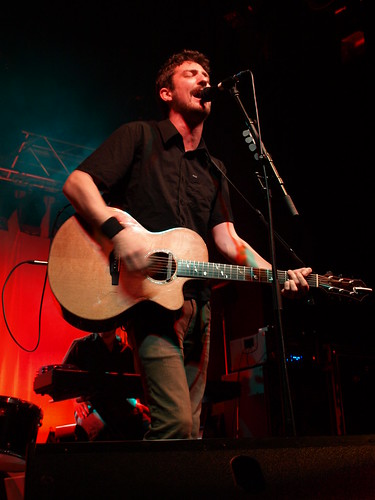
 ’s (photo by Vikki McIntyre) solo career consists of acoustic songs, but these aren’t sit-down acoustic folk ballads; they’re stand up and sing-along acoustic belters. As his tall frame takes the stage as though climbing a victory podium, he’s flanked by a military snare-loving drum kit, embossing bass and supportive electric guitar players, who come and go at various parts of his set. Frank’s songs burst with life-affirming chants, witty rhyming couplets, and wry observations, aimed at the struggling artist that lounges in the heart of Britain’s pint drinking public. Frank is also a card-carrying political libertarian, and his songs resound with anti-Thatcher, anti-9-til-5 political themes.
 ’ and ‘Father's Day’ retread the oft-walked paths of family and personal relationships. While very few of his songs are “love songs” of the clichéd variety, Frank is not above picking the guitar strings to tug on the heart strings.
 last year to play drums for Trent Reznor on the apparent last ever Nine Inch Nails tour. Lostprophets (picture by Andrew Moore) are now on tour now with their new drummer, Luke Johnson, out to prove to the world that they don’t miss him.
 ’ and ‘Last Train Home
 ’ not only get the vast Corn Exchange audience pogoing like 70s punks, but prove uplifting and inspiring. Lyrics like “But there's still tomorrow/ Forget the sorrow/ And I can be on the last train home” breath optimism into a genre too often overfilled with depression and negativity.
 ’. Extended cheering leads to their reappearance, but the encore tune, a song called ‘The Light That Shines Twice As Bright...
 ’ from their January album The Betrayed, is slow, atmospheric and eerie, leaving the audience somewhat bemused by this stylistic sidestep. To come full circle, the song was rather reminiscent of Nine Inch Nails.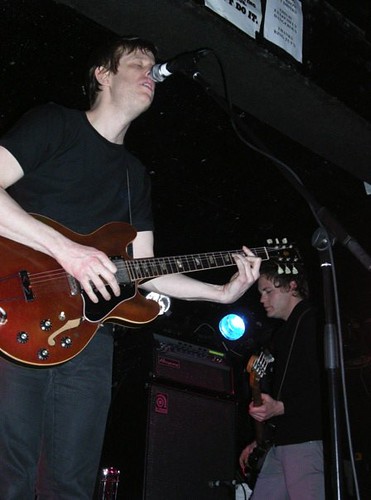
 ’ light rock guitar songs are made especially eerie and dancey as their six-piece line-up includes a percussionist as well as a drummer, who thundered drums and cymbals alike in spite of a rather nasty-looking cast on his arm. The band’s broken-beat Dirty Projectors-style harmonies, subtle use of piano and gritted-teeth lead vocals can be used to create either strange little pop oddities or off-kilter post-rock epics. Add their warm booming basslines and you’ll be following White Rabbits into Wonderland.
 (pictured) are much more rough around the edges, with some spiky guitar clashes, staccato piano and laid-back but agitated vocals. The Texan four-piece’s songs are often made up of minimalist riffs and uncluttered drum parts, allowing the instruments to stay well-separated, creating a sort of hollow space in the middle range for you to listen to the song from. Lyrically, they float between odd and sometimes unreadable metaphors, and sentiments that ultimately convey a general discomfort with the world they inhabit.
 ’ (below) and the sombre but dramatic ‘The Beast and Dragon, Adored’.
 in the green room before their gig at Cabaret Voltaire about bands from Birmingham, the controversial Christmas number one, their new album, and Craig Finn.
 (picture by Edmund Fraser) came on stage, Edinburgh’s smallest venue was packed sardine-style. The band is made up of lead singer girl, Tigs, centre stage, flanked by her two musical lads: Will Sanderson and James Watkins. The drums and most of the bass is pre-programmed and sequenced. The boys play synthesisers most of the set, sounding very 8-bit and glitchy, but will sometimes pick up a guitar or bass to add some buzz. Tigs’s vocal parts are poppy like Little Boots or recent Kylie Minogue.
 ’, whose uplifting melody is a refreshing in contrast to the dance-punk claustrophobia of the rest of the set.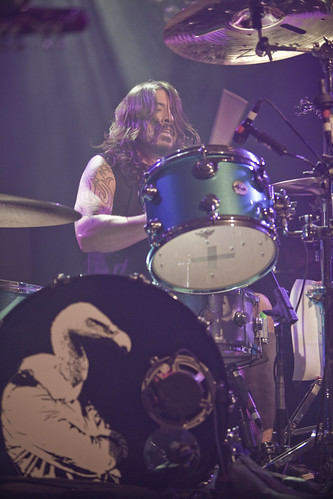
 (photo by Trixta Photography) seem to subscribe to strongly. It’s clear that the band are playing the music they want to play. Clearly written in jams, it seems very little thought has been put into mundane nuances like catchiness, commerciality and accessibility. Instead the band favour concepts like ‘edge’, ‘balls’, and how fun the song is to play.
 (pictured) is quoted as saying, "I think musicians had two business models for thousands of years: the Troubadour, where you had to travel from town to town and sing for your supper, or the Patron, where you courted the favour and worked at the pleasure of the idle rich."
 , a song about the now-grown-up punk scenester’s relationship with the Dead Kennedy's front man. Franz performed the song with enthusiasm, slaughtering his guitar strings and stomping his foot resoundingly on the hard wooden floor, lost in the energy of the song until about two thirds of the way through, where he embarrassingly filled a quieter bit by explaining "this is the part where there's usually a guitar solo".
 . While the San Francisco man, formerly lead singer of American Music Club, also sports a Fedora, a suit and facial hair, their music and performance style differ greatly. Franz bubbles over with positivity, showmanship, and an entertainer's spirit. Mark Eitzel is a different breed. His is a self-deprecating dark humour, and his stories, he contends, intriguing as they may be, are situations were he was in the wrong place at the wrong time. He's almost too shy for the stage, but it would be such a shame if he didn't get up there and tell his crazy stories and sing his beautiful tunes.
 , during which he was joined on stage by Franz Nicolay for accordion and backing vocals.
 have brought intelligence to a genre that demands nothing but passion. The guitar and drums have been carefully formulated to compliment each other very well. The guitar itself is usually highly distorted, but also makes use of muting and bright picking parts in order to provide a wide variety of sounds to Sucioperro's range of tunes, meaning their sound can stretch between uplifting power rock ('Don't Change (What You Can't Understand)
 ') to grunge-metal ('Dirty Dirty Sick Sick
 '). Sometimes the use of guitar goes a step further to a level of some serious creativity; there are some very interesting sliding and harmonic sounds in 'Liquids,' for example.
 (pictured) took to the stage.
